
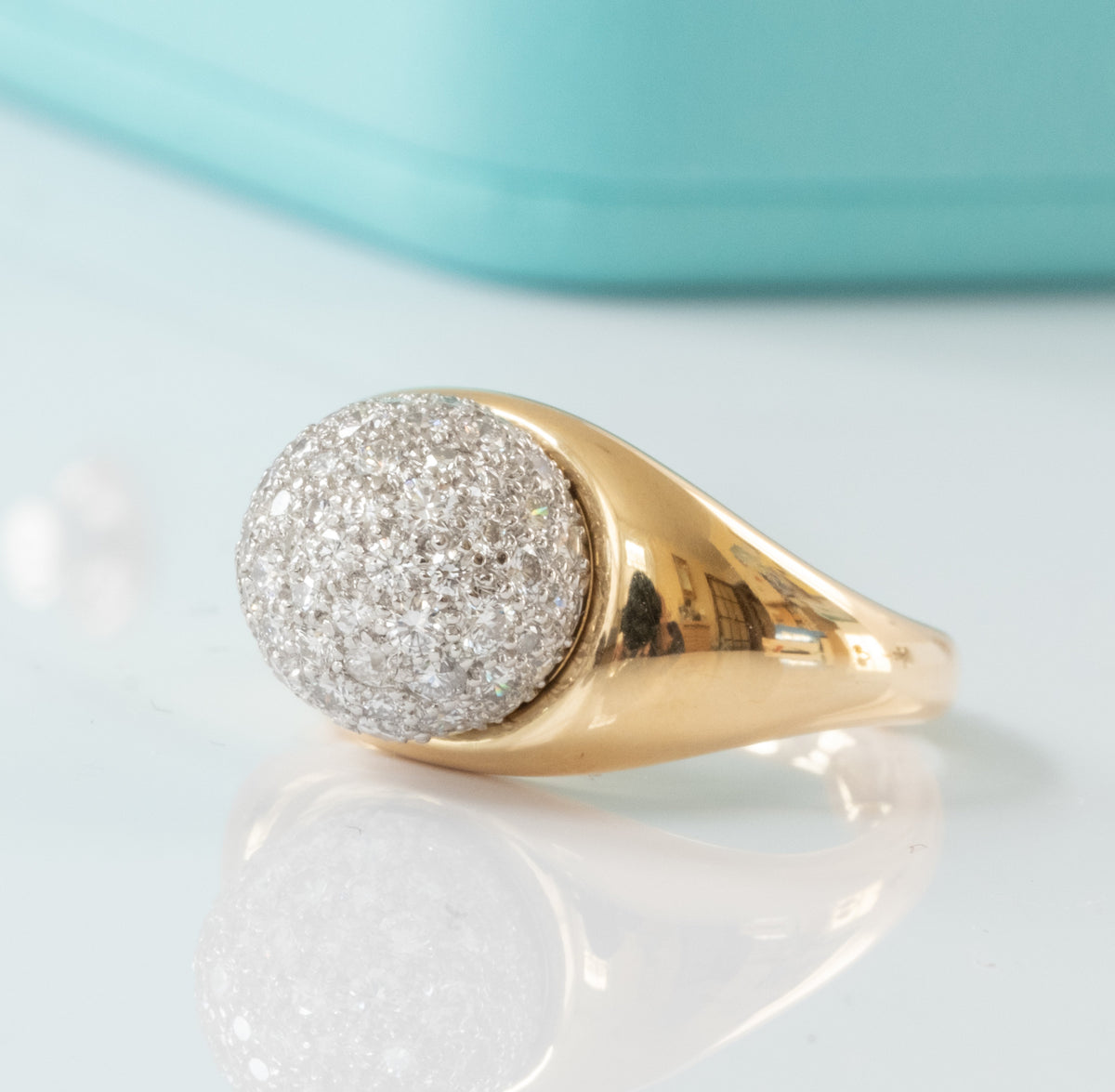
 Paloma Picasso jewelry has never asked permission to be noticed. A red lacquered heart, an emphatic X, a ribbon of gold drawn into a decisive line - her work carries the self-possession of a woman who understands that fine jewelry can be both intimate and unapologetically visible. For collectors, that clarity is precisely the appeal.
Her best designs do more than reference an era. They hold their own beside contemporary tailoring, dramatic evening clothes, and an established personal collection. They are jewels with a point of view.
Why Paloma Picasso Jewelry Still Feels So Modern
Paloma Picasso arrived in jewelry with an unusually complete visual vocabulary. The daughter of Pablo Picasso and artist Françoise Gilot, she grew up close to art but developed a language distinctly her own: sensuous, graphic, urban, and often charged with color. Before her long association with Tiffany & Co., she was already creating jewelry that treated precious materials as a medium for gesture rather than ornament alone.
That distinction matters. Much fine jewelry is designed around a stone, a motif, or a conventional idea of elegance. Paloma Picasso often begins with a line. Her curves can feel like handwriting. Her hearts are not delicate symbols but saturated declarations. Her X designs are crisp, architectural, and faintly subversive. Even when a piece is made in gleaming 18k gold, it rarely feels formal in the expected way.
Her Tiffany & Co. collections, launched in 1980, brought this visual confidence to an international audience. Yet the pieces retain an authorial quality that is especially compelling decades later. A jewel marked Paloma Picasso for Tiffany & Co. is not simply a period accessory. It is a recognizable chapter in late 20th-century design.
The Signatures Collectors Recognize
The most compelling Paloma Picasso pieces tend to be immediately legible from across a room. Her design language favors silhouette, contrast, and an assured use of scale. That makes condition and proportion especially significant: the architecture of the piece is the point.
Graphic Gold and the X Motif
The X motif is among her most enduring signatures. In rings, pendants, earrings, and bracelets, it can appear spare and linear or more dimensional and sculptural. At its strongest, the design has tension: a clean crossing of polished gold that reads as both symbol and abstract form.
For a collector, the appeal lies in its versatility without anonymity. A substantial gold X ring can hold its own as a singular statement, while earrings or a pendant offer the same visual intelligence in a quieter register. The motif is also closely linked to the 1980s, though it avoids the excess often associated with the decade. It is graphic rather than ornate.
Loving Heart and the Power of Red
Paloma Picasso’s Loving Heart designs are among the most personal expressions in her body of work. The heart is rendered with a loose, almost calligraphic quality, as though it were drawn in one continuous motion. This is not sentimental jewelry in the conventional sense. It is jewelry that makes sentiment bold.
Pieces in red lacquer have particular presence. The color is vivid, highly recognizable, and central to Picasso’s aesthetic. A red heart pendant against black, white, camel, or bare skin needs little accompaniment. It brings energy to a collection built around gold and diamonds, and it offers a different form of luxury: emotional, graphic, and exacting.
Lacquer deserves thoughtful attention because its surface is part of the design. Minor evidence of age may be appropriate in a vintage jewel, but deep scratches, chips, or areas of loss interrupt the clarity that makes these pieces so successful. The same principle applies to black enamel and other high-contrast finishes found in her work.
Color as Structure, Not Decoration
Picasso has an exceptional instinct for pairing precious metal with color. Turquoise, amethyst, citrine, peridot, and richly colored lacquer can become integral to the design rather than simply decorative accents. Her work often uses color in broad, confident passages, much as an artist uses pigment to establish composition.
This is why her gemstone jewels can feel so different from traditional cocktail jewelry. The stones are not necessarily there to create a hierarchy of value through size. They contribute attitude, rhythm, and contrast. A jewel’s pleasure may rest in the dialogue between a saturated cabochon, strong gold volume, and a silhouette that refuses to disappear into the wearer’s hand or neckline.
What Gives a Vintage Piece Its Weight
In a mature collection, a Paloma Picasso jewel earns its place through design integrity. The strongest examples have a clear relationship between the original concept and the physical object: crisp edges where the design calls for crispness, balanced curves, well-preserved surface treatment, and a scale that allows the motif to read as intended.
Signatures and hallmarks are essential to the object’s identity. Depending on the period and piece, collectors may encounter Paloma Picasso, Tiffany & Co., metal marks, serial numbers, or other production markings. The placement and execution of these details should be considered alongside the jewel’s construction and overall quality. A signature supports provenance, but it is not a substitute for examining the piece as a whole.
Original boxes and papers can add pleasure and context, particularly for iconic designs or significant gifts. They are not, however, the only measure of desirability. A beautifully preserved, correctly marked jewel with strong design presence may be more compelling than a lesser example accompanied by packaging. As always, condition is best judged in relation to rarity, age, material, and the specific design.
There is also a practical consideration. Large-scale rings, earrings with lacquer or enamel, and dimensional pendants can be more sensitive to hard wear than plain gold pieces. That is not a reason to keep them hidden away. It is simply part of respecting the materials. A collector who wears her jewelry understands that care and pleasure are not opposites.
A Designer for a Personal, Not Predictable, Collection
Paloma Picasso works particularly well for women who do not want every jewel to perform the same role. A diamond rivière may provide refinement. A classic gold bangle may provide daily polish. Then a Paloma Picasso ring, heart pendant, or sculptural earring brings character - the element that makes the collection feel authored rather than assembled.
Her jewelry also has an unusual ability to move between wardrobes. The same bold gold form that sharpens a white shirt can become quietly glamorous with black silk. A colorful pendant can animate minimal clothing without feeling decorative for decoration’s sake. These are pieces for women who dress with intention and prefer a memorable detail to an obvious display.
At All The Best Vintage, rare finds are our specialty, and Paloma Picasso remains a designer worth watching closely. Her finest vintage jewels offer more than a famous name: they bring line, color, and conviction to the way a collection is worn. When the right example appears, its appeal is immediate - and its place in a discerning jewelry wardrobe is easy to understand.

Commenta
Questo sito è protetto da hCaptcha e applica le Norme sulla privacy e i Termini di servizio di hCaptcha.